
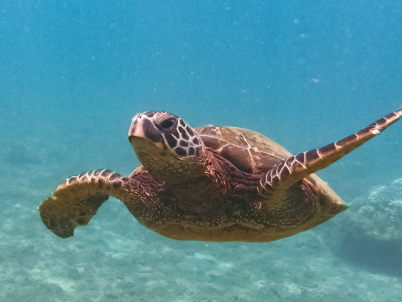
In Florida, manatees and sea turtles face critical and overlapping threats related to human expansion and environmental degradation. Here is an overview of the current situation for these protected species.
Manatees
Year after year, data from the State of Florida confirm that boat strikes are one of the leading causes of manatee mortality due to human activity in the Sunshine State, alongside natural causes such as cold stress and starvation resulting from the loss of seagrass beds—which is itself a consequence of pollution.
In the spring of 2026, it was reported that at least 72 manatees were killed in collisions with boats, including 13 in Lee County (Fort Myers area). Why? Speed! For example, at the entrance to Back Bay in Fort Myers Beach, boaters are supposed to slow down as they approach, as clearly indicated on the signs at the bay’s entrance. But witnesses say that too many boaters continue to ignore this requirement. “We see a lot of people passing through here, and they’re going too fast,” a captain from Salty Sam’s Sightseer told Gulf Coast News. As a result, marine wildlife is paying the price, injured by boat propellers. One visitor told the TV station that boaters don’t even see the marine animals because they’re going so fast!
Park ranger Rob Howell recounts trying to save a pregnant female manatee that was injured by a boat last May. Watching her die broke his heart. Then, the following week, another manatee died… Howell explains that he’s been seeing more and more injured or dead animals in Back Bay lately. Awareness and education, as well as compliance with regulations, are definitely needed.
Wildlife advocates in Florida are constantly concerned about recreational boaters’ excessive speed, claiming that their actions endanger manatees and other marine species, such as sea turtles.
Sea Turtles
Sea turtles face not only serious injuries from collisions with boats but also coastal erosion and disturbances during nesting, including this year’s abundant presence of Sargassum seaweed.
Thick, dense mats of Sargassum along the coastline prevent adult females from reaching dry, safe sand to lay their eggs, forcing them to abandon their nests or expend vital energy.
Furthermore, once the baby turtles emerge, the enormous piles of seaweed become insurmountable “Mount Everests.” The hatchlings can become entangled, get stuck on their backs, or become exhausted, making them vulnerable to predators as well.
Finally, as the seaweed decomposes on the beach, it releases hydrogen sulfide and alters the temperature and gas exchange within the nest, which can impact the survival and development of unhatched eggs.
The sea turtle nesting season in Florida officially runs from March 1 to October 31, with nesting peaking from June to July.